
buildwithhashir.com

Uncategorized

Uncategorized

Why Your Customer Journey Map Is Probably Outdated

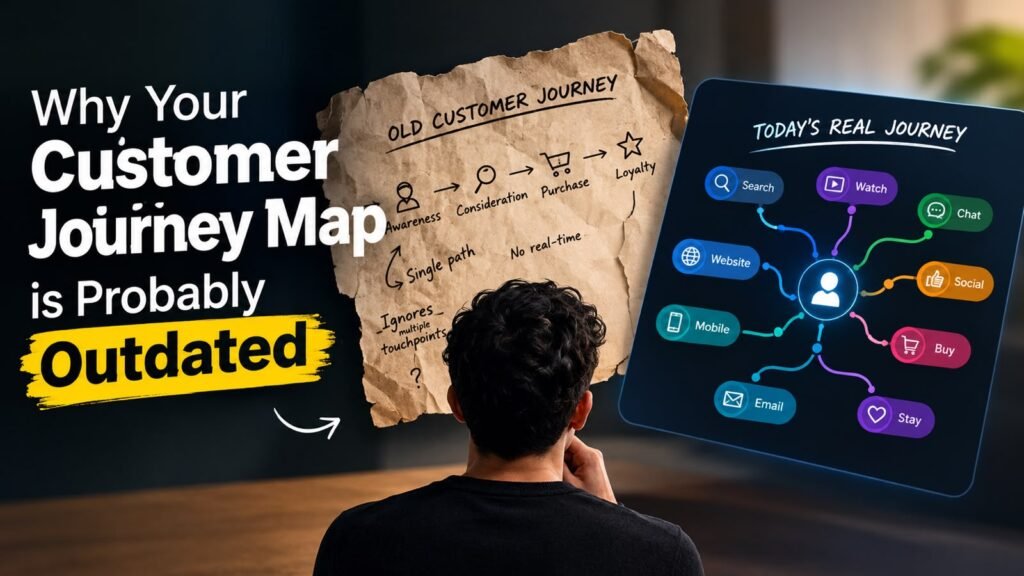
Somewhere in your company, a customer journey map is gathering dust. It’s likely a slide or a polished photo of a whiteboard, with neat stages like Awareness, Consideration, Purchase, Retention, and Advocacy. It was born in a workshop full of sticky notes and good intentions. It’s probably wrong. Your team didn’t do bad work; customer behavior simply moves faster than most maps get updated. Why Classic Journey Maps Fail Traditional maps start with assumptions. A group of smart people imagines what a “typical” customer thinks and does, maybe backed by a few interviews or a survey. The result is a clean, linear story. Real life isn’t. They’re snapshots. A map drawn in Q1 reflects Q1 pricing, channels, and competitors. By Q4, your product and marketing have shifted, but the map hasn’t. They assume a straight line. Actual customers loop, pause, skip, and backtrack. Someone might read a review, vanish for three months, click a retargeting ad, text a friend, abandon a cart, and finally buy on their phone at 11pm. They rely on opinion over action. People are unreliable narrators of their own behavior. They forget details and rationalize decisions after the fact. They blend everyone together. A first-time buyer, a loyal repeat customer, and a B2B champion navigating procurement do not travel the same road. They have no owner. Most maps are one-off projects. Without someone responsible for upkeep, they become decoration. Is Your Map Out of Date? A Quick Test Hesitate on more than one? Time to rebuild. How to Rebuild Around Real Behavior Data The goal isn’t a prettier diagram. It’s a living model of how customers actually move, tied to evidence. Decide what the map must help you solve: churn, onboarding drop-off, poor trial conversion. A map built for one question is sharper than a generic end-to-end chart. Behavior tells you what happened. Conversations tell you why. Start with behavior so your research is focused. Use path and cohort analysis to find: Expect surprises: some stages on your old map will barely exist, and key moments will be missing. Don’t produce a single map. Group customers by what they do: fast converters versus slow researchers, self-serve versus sales-assisted, highly engaged versus quiet in the first 30 days, or by acquisition channel. Two or three distinct journeys often explain most of your customers, far better than one average that describes no one. These become your improvement priorities. Now aim qualitative research at the patterns you found. If many people leave after the pricing page, interview them. If a support issue spikes in week two, listen to those calls. This is where motivation and emotion come in. For each stage, record what customers do (with the metric), what they want, where they struggle, who owns that moment, and what action to take. Label anything still unproven as a hypothesis.8. Keep it alive Most teams stop here. Don’t. Common Pitfalls Drowning in data. Focus on the question from step one.Ignoring qualitative input. Numbers show the pattern, not the reason.Over-polishing. A rough, accurate map beats a beautiful, wrong one.Going solo. Involve marketing, product, sales, and support so every view is represented.Final Thought A journey map shouldn’t be a poster; it should be a working tool that evolves as customers do. Ground it in what people actually do, segment it, assign an owner, and refresh it regularly. You’ll stop guessing and start making decisions with confidence. This is written from scratch, so it’s original, but I can’t run a plagiarism scan myself. For a verified result, paste it into Copyscape, Grammarly, or Quetext. I can also add an SEO title, meta description, or a call-to-action, or save it as a file if you’d like.

Uncategorized

How to start antigravity ?n

Why Defying Gravity Is So Much Harder Than Science Fiction Promised Few ideas in physics capture the imagination quite like antigravity. It’s the technology that lets flying cars hover in Blade Runner, the force that levitates Marty McFly’s hoverboard, the dream that would let us build space elevators and floating cities. But strip away the science fiction, and antigravity turns out to be one of the most misunderstood and most rigorously tested concepts in modern physics. Here’s what it actually means, what real experiments have found, and why “falling up” is so much harder than Hollywood makes it look. What Do We Actually Mean by “Antigravity”? Before diving in, it’s worth separating three very different things people lump under the word “antigravity”: Most “antigravity” claims in pop culture and pseudoscience quietly slide between these categories. The genuinely interesting physics question is the first one: can gravity, as a force, ever push instead of pull? Gravity Isn’t Like the Other Forces To understand why antigravity is so stubbornly difficult, you have to understand what gravity actually is according to our best theory, Einstein’s general relativity. Electromagnetism has positive and negative charges, and opposite charges attract while like charges repel which is exactly the kind of two-sided behavior that makes repulsion easy. Gravity has no equivalent. In general relativity, gravity isn’t really a force at all it’s the curvature of spacetime itself, caused by the presence of mass and energy. Objects don’t get “pulled,” they just follow the straightest possible path through a warped fabric of space and time, the way a marble rolls toward the dip made by a bowling ball on a stretched sheet. Because every form of energy and every observed type of mass warps spacetime in the same direction creating a dip, never a bump there’s no known “negative charge” equivalent for gravity. Every particle we’ve ever detected, no matter how exotic, curves spacetime the same way. That’s the core reason antigravity is so hard: it’s not that we lack the engineering, it’s that we’ve never found the raw ingredient. Does Antimatter Fall Up? Physicists Just Checked For decades, one loophole kept the antigravity dream alive: antimatter. Every particle has an antiparticle with opposite charge could antimatter also have “opposite” gravity, and fall upward instead of down? It sounds like exactly the kind of asymmetry the universe might hide. In 2023, the ALPHA collaboration at CERN finally settled the question experimentally, after roughly three decades of preparation. Researchers trapped ultra-cold antihydrogen atoms the antimatter counterpart of hydrogen inside a vertical magnetic bottle called ALPHA-g, then slowly weakened the trap’s fields until gravity could pull the atoms out one end or the other. Scientists had long theorized antimatter should respond to gravity just like regular matter, but no one had ever actually observed the effect happen. The result was about as clean as a “yes” or “no” in physics ever gets. Researchers calculated that if antimatter behaves like ordinary matter, roughly 80 percent of released atoms should fall downward and escape from the bottom of the trap, with the rest slipping out the top. That is exactly what happened within the experiment’s margin of error, physicists found no detectable gravitational difference between antihydrogen and ordinary hydrogen. As one Berkeley researcher on the team put it, this stood as the first true “Leaning Tower of Pisa” experiment ever performed with antimatter. The takeaway, bluntly: for antimatter at least, antigravity doesn’t exist gravity pulls antihydrogen downward, not upward. The measurement effectively ruled out a class of antigravity theories, though researchers note the error bars are still significant enough that even more precise follow-up tests are planned. It was a genuinely historic result the first direct observation of gravity acting on antimatter and it closed off one of the last plausible physical mechanisms for natural antigravity. What About Exotic Matter and Negative Mass? If antimatter is out, theorists have another candidate: “negative mass” or “exotic matter” hypothetical material with negative energy density. On paper, general relativity’s equations don’t forbid it outright, and negative-mass fluids show up as a mathematical possibility in solutions describing wormholes and the Alcubierre “warp drive.” In those models, exotic matter is exactly what would be needed to hold a wormhole open or bend spacetime into a repulsive bubble. The catch is that no negative-mass particle has ever been observed, and there are strong theoretical reasons (like the “energy conditions” built into general relativity) to suspect ordinary matter can never behave that way at any density we could realistically create. Some laboratory analogues using Bose-Einstein condensates cooled to near absolute zero have produced fluids that briefly behave as though they had negative effective mass, accelerating toward a pushing force rather than away from it. These are fascinating quantum effects, but they’re a mathematical curiosity confined to ultracold atom clouds, not a step toward a hovering vehicle. The Quantum Vacuum and the Casimir Effect A more speculative thread of antigravity research involves the quantum vacuum the idea that “empty” space is actually seething with virtual particles popping in and out of existence. The Casimir effect, in which two uncharged metal plates placed extremely close together are pushed together by vacuum fluctuations, is real and experimentally confirmed. Some fringe theories have proposed that carefully engineered materials superconductors, metamaterials, or specific geometric arrangements might locally modify this vacuum energy in a way that produces a repulsive gravitational effect. This is the territory occupied by the most famous “antigravity” claim in modern physics: Russian scientist Evgeny Podkletnov’s 1990s assertion that a rapidly spinning superconducting disc could shield objects above it from gravity, reducing their weight by around 2%. The claim generated enormous media attention and even drew interest from NASA and Boeing, but independent labs were never able to reproduce the effect, and the physics community now regards it as flawed methodology rather than a genuine discovery. NASA’s own Breakthrough Propulsion Physics Project, which ran from 1996 to 2002 specifically to investigate ideas like this, ultimately closed without validating any antigravity mechanism.

best blog
Uncategorized

How to Run a Business: A Practical Guide for Getting It RightStarting a company is the easy part. Here’s what separates the businesses that last from the ones that don’t — nine principles, no fluff

01Get clear on your whyBefore anything else, define why your business exists — not just “to make money,” but what problem you solve and for whom. This clarity becomes the filter for every decision that follows: which products to build, who to hire, which opportunities to chase, and which to let pass. 02Build a plan that stays aliveYou don’t need forty pages nobody will read. You need answers to four questions: Who is your customer, specifically? What do you offer that they can’t easily get elsewhere? How will you make money? And what will it cost to run, so you know when you break even? Revisit these answers every quarter. A plan that never changes isn’t being used. 03Master your cash flowMore businesses fail from running out of cash than from lack of profit. Know your numbers weekly: What’s coming in, and whenWhat’s going out, and whenHow much runway you’d have if revenue stalled tomorrowKeep a buffer. Invoice promptly. Chase late payments without apology — it’s your money. “Profitable on paper” and “cash in the bank” are two different sentences. Only one of them pays your rent.04Hire slowly, address problems fastYour team sets your ceiling. Hire for attitude and trainability over a flawless résumé when you can, but never lower the bar just to fill a seat. When someone clearly isn’t working out, address it quickly and respectfully — a delayed conversation costs more morale than a direct one. 05Write down how things get doneIf a task happens more than twice, document it. Simple, written procedures mean your business doesn’t depend entirely on you, new hires ramp up faster, and quality holds steady even when you’re not watching. This is the line between owning a job and owning a business. 06Know your numbers, not just your instinctTrack what actually predicts health: revenue, gross margin, customer acquisition cost, lifetime value, churn. Instinct is good for spotting a problem. Numbers tell you whether it’s real, and how big. 07Talk to your customers, oftenMarkets move faster than most owners realize. Regular, honest conversations with customers — not just surveys — surface problems and openings long before they show up in your sales data. 08Protect your own energyBurnout kills more businesses quietly than bad strategy does. Set working hours. Delegate what isn’t your highest-value work. An exhausted, reactive owner rarely makes good decisions. 09Expect to revise the planNo business runs exactly as intended. The owners who succeed aren’t the ones who predicted everything correctly — they’re the ones who noticed reality diverging from the plan early, and adjusted without ego. The bottom lineRunning a business well isn’t one big breakthrough. It’s disciplined attention to cash, people, customers, and systems, repeated month after month. Get the fundamentals right, and growth tends to follow.

Uncategorized

How to Start Freelancing Work

How to Start Freelancing Work: A Complete Beginner’s Guide Freelancing has become one of the most popular career choices for professionals who want flexibility, independence, and unlimited earning potential. Whether you’re a student, a fresh graduate, or an experienced professional, learning *how to start freelancing work* can open the door to exciting opportunities across the globe. The digital economy has made it easier than ever to connect with clients, showcase your skills, and build a successful freelance business. With the right strategy and consistent effort, anyone can begin their freelancing journey. What Is Freelancing? freelancing is a way of working independently by offering your services to different clients instead of working as a full-time employee for one company. Freelancers can work from anywhere, choose their projects, and set their own schedules. Popular freelance services include: * Digital Marketing* Graphic Design* Web Development* Content Writing* SEO* Video Editing* Social Media Management* Virtual Assistance* UI/UX Design ## Why Choose Freelancing? There are many reasons why people choose freelancing as a career: * Flexible working hours* Work from anywhere* Unlimited earning potential* Opportunity to work with international clients* Better work-life balance* Continuous learning and skill development Although freelancing offers many advantages, success requires patience, consistency, and professionalism. ## How to Start Freelancing Work Successfully ### 1. Identify Your Skills The first step is understanding what services you can provide. Think about your strengths and areas of expertise. For example: * Digital Marketing* Search Engine Optimization (SEO)* Social Media Marketing* Website Development* Content Creation* Copywriting* Graphic Design If you’re just starting, invest time in learning high-demand digital skills through practice and online courses. ### 2. Build Your Portfolio Clients want proof of your abilities before hiring you. Create a professional portfolio that includes: * Your best projects* Case studies* Certifications* Testimonials* Skills and tools you use* Contact information A well-designed personal website increases your credibility and helps clients trust your expertise. ### 3. Choose Your Freelance Niche Instead of offering every possible service, focus on one niche where you can become an expert. Examples include: * SEO Specialist* Digital Marketing Strategist* Content Writer* Web Designer* Social Media Manager Specialists often attract higher-paying clients than generalists. ### 4. Create Profiles on Freelance Platforms Register on trusted freelance marketplaces to find your first clients. Popular platforms include: * Upwork* Fiverr* Freelancer* People Per Hour* Guru Complete your profile with a professional photo, clear service descriptions, and portfolio samples. ### 5. Set Competitive Pricing Many beginners make the mistake of charging too little. Research your industry and choose pricing based on: * Experience* Skill level* Project complexity* Market demand As your experience grows, gradually increase your rates. ### 6. Learn Client Communication Communication is one of the most valuable freelance skills. Always: * Respond quickly* Ask clear questions* Meet deadlines* Be transparent* Maintain professionalism Satisfied clients often become repeat customers and recommend your services to others. ### 7. Keep Improving Your Skills The digital industry changes rapidly. Stay updated by learning: * New marketing strategies* AI tools* SEO trends* Social media updates* Website technologies Continuous learning keeps you competitive. ## Common Mistakes Beginners Should Avoid Many new freelancers struggle because they: * Skip building a portfolio* Accept every project without planning* Miss deadlines* Ignore client communication* Stop learning new skills* Expect instant success Avoiding these mistakes can help you build a strong reputation. ## Tips for Long-Term Freelance Success Successful freelancers consistently: * Deliver high-quality work* Build long-term client relationships* Learn new technologies* Create a personal brand* Ask satisfied clients for testimonials* Improve their portfolio regularly Consistency is often more important than perfection. ## Final Thoughts Understanding *how to start freelancing work* is only the beginning. Building a successful freelance career takes dedication, continuous learning, and a commitment to delivering value to every client. Whether your goal is to earn extra income or build a full-time business, freelancing offers endless opportunities in today’s digital world. Start by mastering one valuable skill, creating a professional portfolio, and applying for projects consistently. Every successful freelancer started with a single client, and your journey can begin today. If you’re ready to grow your online career, start taking action now. With patience and persistence, freelancing can become a rewarding and sustainable profession.

Scroll to Top